A website relaunch is coming up – and you want to make sure your previous rankings and SEO successes aren't lost? You're unsure how your current SEO performance can be maintained with the new CMS / shop system? Or you want to use the upcoming technology migration to factor SEO in right from the start?
Whatever the reason: We help you identify key SEO topics early during a relaunch, prioritize them cleanly, and execute them efficiently.
Why is SEO so important during a relaunch?
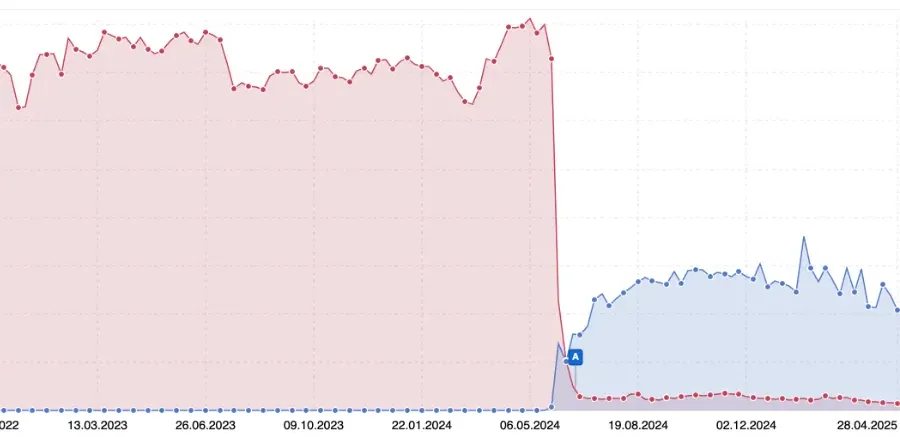
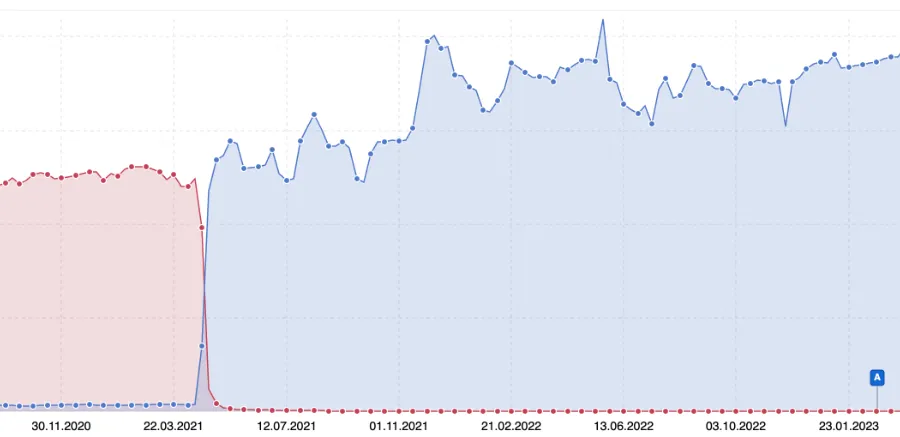
A relaunch is the "safest" way to jeopardize your website's visibility – at least if you ignore SEO or bring it in too late.
Sistrix visibility when a relaunch fails (Source: Sistrix)
Sistrix visibility with a successful relaunch (Source: Sistrix)
The reason: Major structural or technical changes – CMS migration, new frontend, design update, new URL structure – will most likely cause Google to re-evaluate your entire domain. Without search engine-friendly execution, this means:
Relevant pages are no longer found
Technically caused duplicates emerge
Backlinks point to dead ends
The result: Rankings collapse – and with them organic traffic. It doesn't have to be this way.
Factor "SEO" into the earliest planning phase of your relaunch – this minimizes potential risks and maximizes the chance of noticeably boosting your SEO performance post-go-live.
Daniel Kremer, SEO Expert
Together toward the best result
We ensure that SEO does not become a side note during a relaunch. We make clear recommendations for efficient implementation and prioritize truly relevant action fields – including mission-critical tasks such as redirect mapping.
Consulting before, during, and after the relaunch
We accompany you across the entire relaunch process in all key phases:
1
Kick-Off
Requirements and expectations
Key questions to clarify
Why is the relaunch taking place?
What is the goal of the relaunch?
What all is being changed?
What is the timeline?
Which stakeholders are involved?
Who is responsible for which topic?
Pre-Launch
Planning and preparation
For later before-and-after comparison, we capture the status quo via a structured inventory of the existing website – including all relevant SEO data like URLs, traffic, rankings, backlinks, and technical aspects.
For a structured approach we then compile:
an SEO specification document
overview of weaknesses and strengths of current status quo
URL & structure planning
comprehensive redirect mapping
optional
Keyword analysis and content strategy
Basic SEO training for everyone creating content or editing pages (e.g. editorial staff, marketing, or developers) to prevent common errors
2
3
Launch
Implementation and auditing
SEO check of the new website on staging environment
Testing new structure, URLs, internal linking, etc.
Ensuring no test content or sensitive data is publicly accessible
Auditing 301 redirects on staging (checking for redirect chains or loops)
Go-Live Testing:
Post-go-live immediate checks for crawlability, indexability, re-testing redirects, broken links, etc.
Post-Launch
Monitoring and optimization
Error & Performance Monitoring:
Monitoring error reports, rankings, traffic, and crawling data via tools like Google Search Console and Analytics.
SEO early warning system: Identifying fluctuations and potential issues (e.g. lost rankings)
Correction and fine-tuning
Focus on touch-ups: Topics deliberately deferred for go-live are systematically caught up on (relevance > 100% solution)
We are also happy to support you during an active relaunch process. Starting from your current state, we work to achieve the best possible result for all SEO-relevant topics in the remaining execution phase.
Most common SEO mistakes during a relaunch
Staging/test environment is not password protected
Redirects are forgotten or incorrect
Use of SEO-unfriendly tech stacks
If the test environment is not properly locked, it can be indexed by search engines, resulting in duplicate content (in the worst case, each URL has an exact duplicate in the index).
Google could rate the staging page as the “better” page and downgrade the original page due to duplicate content.
Internal and external links that point to the staging environment could negatively impact the ranking and authority of the real site.
Search engines can crawl and index confidential or unfinished content.
If old URLs lack proper redirects, this results in 404 error pages and a poor user experience.
Missing or incorrect redirects mean that valuable backlink power is not transferred to the new pages.
Pages that are not redirected correctly (e.g., HTTP 301 vs. 302 or generic redirect rule to the homepage) lose their existing SEO rankings, which leads to a drop in traffic and possibly soft 404 errors.
If redirects lead to a chain (redirect chain) or loop (redirect loop), search engines cannot index or access the pages (correctly).
If the entire content of the page is loaded dynamically via JavaScript, search engine crawlers may have problems indexing the entire content.
Custom HTML tags or web components do not convey semantic structure and are therefore usually not interpreted correctly by search engines, which can affect indexing and ranking.
A JavaScript- heavy page can lead to slow loading times, which negatively impacts both the user experience and SEO rankings.
Certain technologies or the way content is embedded can prevent search engines from effectively crawling the page, resulting in poor indexing.
Tip: Always use HTTP Basic Authentication
Tip: Always use detailed redirect mapping
Tip: Consider server-side rendering and similar approaches
SEO-friendly CMS Migration
When switching Content Management or Shop Systems, the same rules apply as for any relaunch – plus technology-specific nuances. Issues usually arise from missing standard integrations or system-specific restrictions. The need for tailored solutions is especially apparent in:
Ability to integrate Schema Markup (structured data)
Complete and automated XML sitemaps
Easily configurable robots.txt
Handling language and country variants (hreflang)
Platform Experience
SEO-friendly Design Relaunch
Looking to "just" update look & feel? Sounds harmless – but even if content and structure stay identical, changes to design, templates, or frontend code can have noticeable impacts on your SEO success. Common pitfalls:
Missing or flawed semantic HTML structures
Inconsistent headline hierarchy
Unfavorable internal linking implementation
Dynamically loaded content that isn't indexed
We review your planned design adjustments in advance for SEO compatibility – ensuring your relaunch doesn't become a stumbling block.
AI mapping instead of endless redirect tables
Manual mapping is yesterday. Using our AI setup based on vector embeddings, we identify matching target pages for thousands of URLs at the push of a button – precise, robust, and scalable.
SEO-friendly Domain Switch
Whether rebranding, corporate acquisition, or merging subdomains: Most challenges of a full relaunch also apply to a seemingly simple domain switch. With a clear strategy, thoughtful redirect concept, and precise technical execution, it runs smoothly.
GEO-friendly Relaunch
A redirect is an instruction for crawlers – not a learning signal for language models. What an LLM knows about your brand is stored in its training data, and a 301 does not change that. After rebranding or a domain switch, ChatGPT & Co. often continue to cite the old name or link to the old domain for a long time. Live-connected AI search models update faster than static model weights – you must address both.
The transition must be linguistically anchored so models can re-learn the new association from text:
Sentences connecting both names – "X is now Y" on homepage, About Us, and FAQs. A silent name swap cannot be learned by a model.
Press releases and Digital PR – Third-party sources carry more weight than self-statements. Include the old name there as well.
Update structured sources – Wikipedia/Wikidata, business directories, industry portals, and social profiles. These are precisely what AI systems cite as proof.
We plan this part of your relaunch as well – and track when models catch up using our AI Brand Monitoring.
What we stand for. And what you can rely on.
High-End Expertise
Best-in-Class SEO & Coding Know-How
Hands-on Consulting
Pragmatic solutions that deliver direct results
100% Data-Driven
Making success transparently measurable
Impact over Scale
Genuine partnership over scaling at all costs
What it's like to partner with ONE Beyond Search
Fill out the contact form
Free initial consultation
Offer and project start
Project progress and reporting
A brief and concise description of your request will help us to process it quickly and efficiently. We will contact you within 48 hours to arrange an appointment for an initial consultation.
We get to know each other during the initial consultation. We clarify your current situation and the goals you want to achieve. We then agree on the appropriate service packages and framework conditions in order to create a tailor-made offer.
We begin our collaboration once the offer has been signed. To get started, we organize a kick-off meeting with all relevant stakeholders to clarify any open questions, refine objectives, and begin implementation immediately.
We will keep you regularly informed about progress, provide reports, and discuss the results. Regular feedback and review sessions are planned for ongoing projects in order to continuously improve our collaboration.
Get in touch with us
We look forward to your inquiry! We are happy to advise you without obligation on the right relaunch support. Or send us an email directly to: hello@onebeyondsearch.com
Vielen Dank.
Wir haben Ihre Anfrage erhalten und melden uns umgehend bei Ihnen.
Frequently asked questions
A relaunch makes sense when your website is technically outdated, no longer meets current design or usability standards, or your brand strategy, products, or target audiences have changed. A CMS migration, a new domain, or a strategic SEO pivot can also justify a relaunch.
Key takeaway: Anyone planning changes should prepare strategically. ONE Beyond Search is the right partner by your side.
Yes, we can. And don't panic – you are not alone. We analyze the status quo, identify root causes, and help repair or contain damage and get your SEO performance back on track. Reach out to us!
If your URLs are changing, your content should ideally remain unchanged at first during relaunch.
Wait on major content revisions until Google & Co. have processed redirects and new URLs display in search results. This prevents Google from evaluating domain changes, technical adjustments, and new content simultaneously – which could trigger a complete re-evaluation of your pages / domain.