













Writing content with AI has long been a daily reality, albeit to varying degrees: from minor phrasing assistance to full text generation. Anyone who still relies solely on manual copywriting is missing out on massive potential in terms of speed and scalability.
Efficiency increasingly determines who can keep up when handling large volumes of content. Those who invest strategically in an automated workflow now can scale long-term, rather than starting from scratch with every single text.
That is exactly what ONE Content Lab is designed for: SEO and AI search expertise is built directly into the workflow, not just added as an afterthought. Our experts will guide you in setting up the process that fits your needs. The Human in the Loop remains indispensable, which is why editorial quality assurance is a core, non-negotiable component, not an optional extra.
How does AI content creation work in daily editorial practice?
For us, AI content creation is not just a single prompt. Instead, it is an orchestrated pipeline of three sequential, building steps. Each step has its own task, its own data sources, and its own checkpoints before the next phase begins.
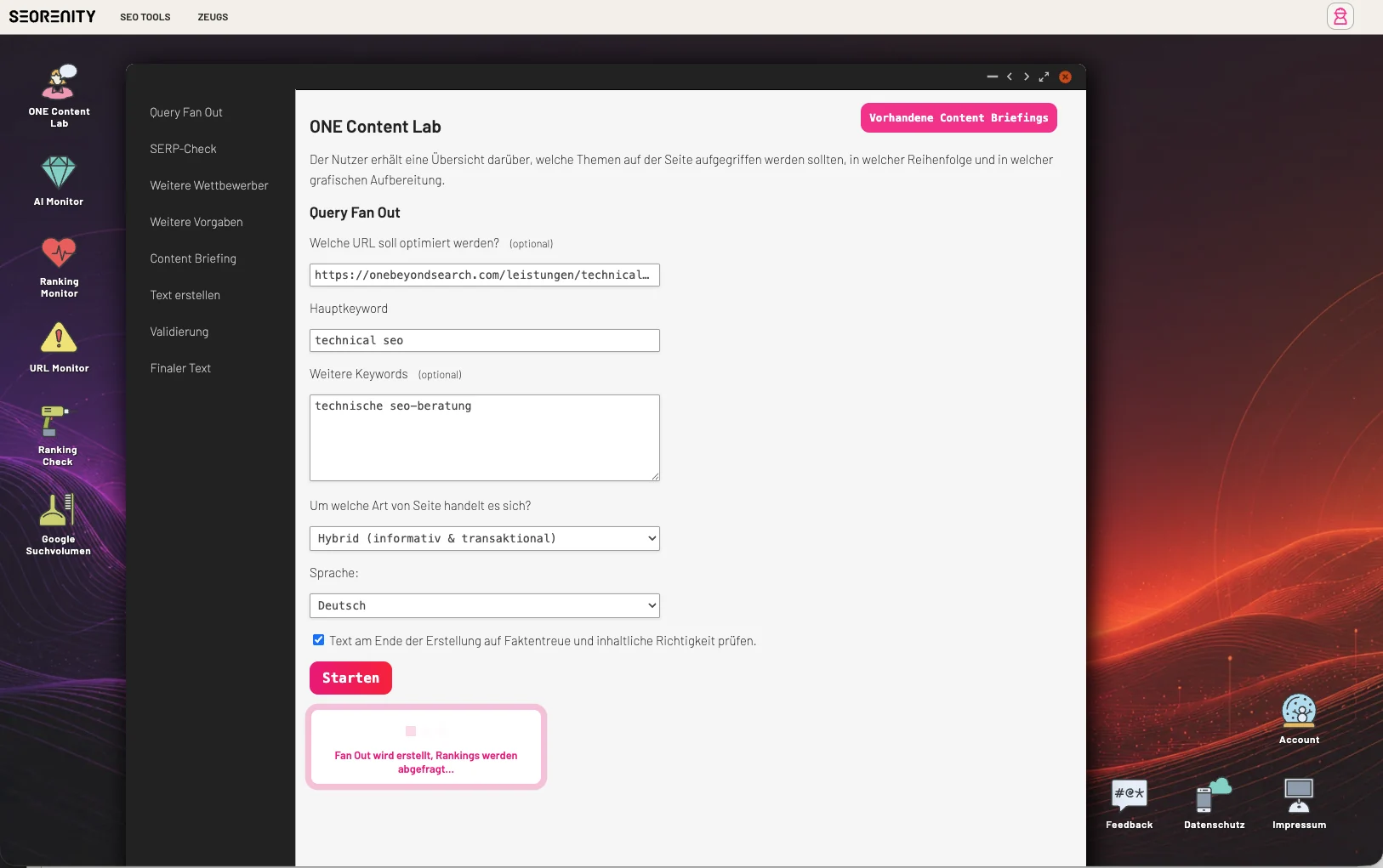
- Step 1: Query Fan-Out and SERP Check
The target keyword is split across multiple models in parallel to uncover all relevant search intents. Real "People Also Ask" questions from Google and live SERP data of top competitors are integrated directly. - Step 2: Content Briefing and Gap Analysis
Your target URL and all relevant competitor pages are read live, not guessed from stale training data. This results in a prioritized briefing: which topics are missing, where competitors remain superficial, and which format is ideal. - Step 3: Content Generation and Validation
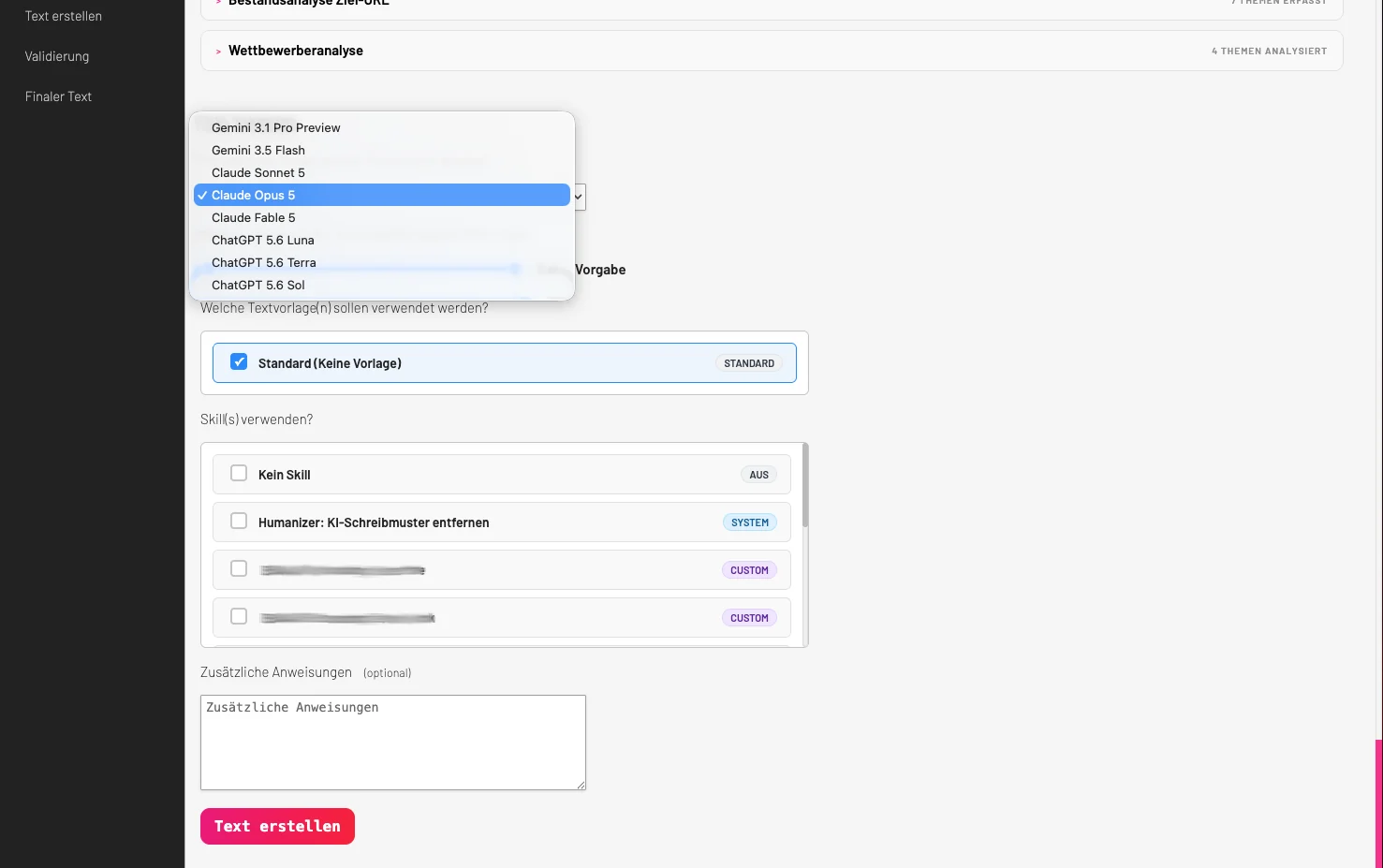
The briefing is transformed into actual text. A second, independent model then cross-checks every number, technical term, and causal statement against live web sources before the text is sent to your editorial team or our quality assurance specialists.
Crucially: you decide how far down the pipeline you want to go. Sometimes, an excellent, ready-to-use content briefing is all your in-house team needs—Steps 1 and 2 deliver exactly that in no time. If you want the final, validated text generated immediately, Step 3 runs automatically. Both approaches work within the same system, with no detours and no need to jump between different tools.
Multiple AI models instead of a single, over-optimized mega-prompt
We deploy each model where it shines brightest. Gemini handles research and grounding via native Google Search and URL context connections. Claude ensures structured outputs and a consistent brand voice. ChatGPT delivers creative phrasing where standard templates might sound generic. During the Query Fan-Out, we even query Gemini and Claude in parallel and deduplicate the results to cover a broader spectrum of keywords and topics than any single model could manage on its own.
Grounding instead of hallucinations
The most tangible difference to basic AI text generators: at multiple points in our pipeline, the system integrates real-time data instead of guessing what might be on a website. Using the Google Search API, we identify actual "People Also Ask" questions during the Fan-Out, while Live Rankings fetch the actual top 10 competitors. During briefing, URL Context reads both competitor pages and your own target URL live, rather than guessing from training data. In the validation step, Google Search matches every statement in the completed text against current sources, and the NL Entity API identifies entities that your target URL shares with the most relevant competitors.
Validation Agent: a second model checks the first
After text generation comes a dedicated verification step: a second, independent model evaluates every figure, industry term, and causal statement against live web sources. This flags plausible-sounding but fabricated details before any human editor ever sees the text.
Human in the Loop at every step
No blind automation: your editorial team maintains full control at every stage. For example, right after the Fan-Out, the interface displays:
- Fan-Out Queries, all as checkboxes. The editorial team selects their preferences or enters a completely manual Fan-Out.
- SERP Competitors: the top 10 rankings are displayed. Relevant competitors can be selected, and additional URLs can be added manually.
- Additional Guidelines via a free-text field, which flows directly as a prompt addition into the next step.
- Fan-Out Override: optionally, the generated Fan-Out can be fully replaced with a manual input for maximum control in specific cases.
In addition, every text undergoes a sentence-by-sentence self-check for typical "AI footprints" and redundancies before approval. Only then does it make its way into your CMS.